
Welcome to the Labyrinth at Christ Church Cathedral
What is a Labyrinth?
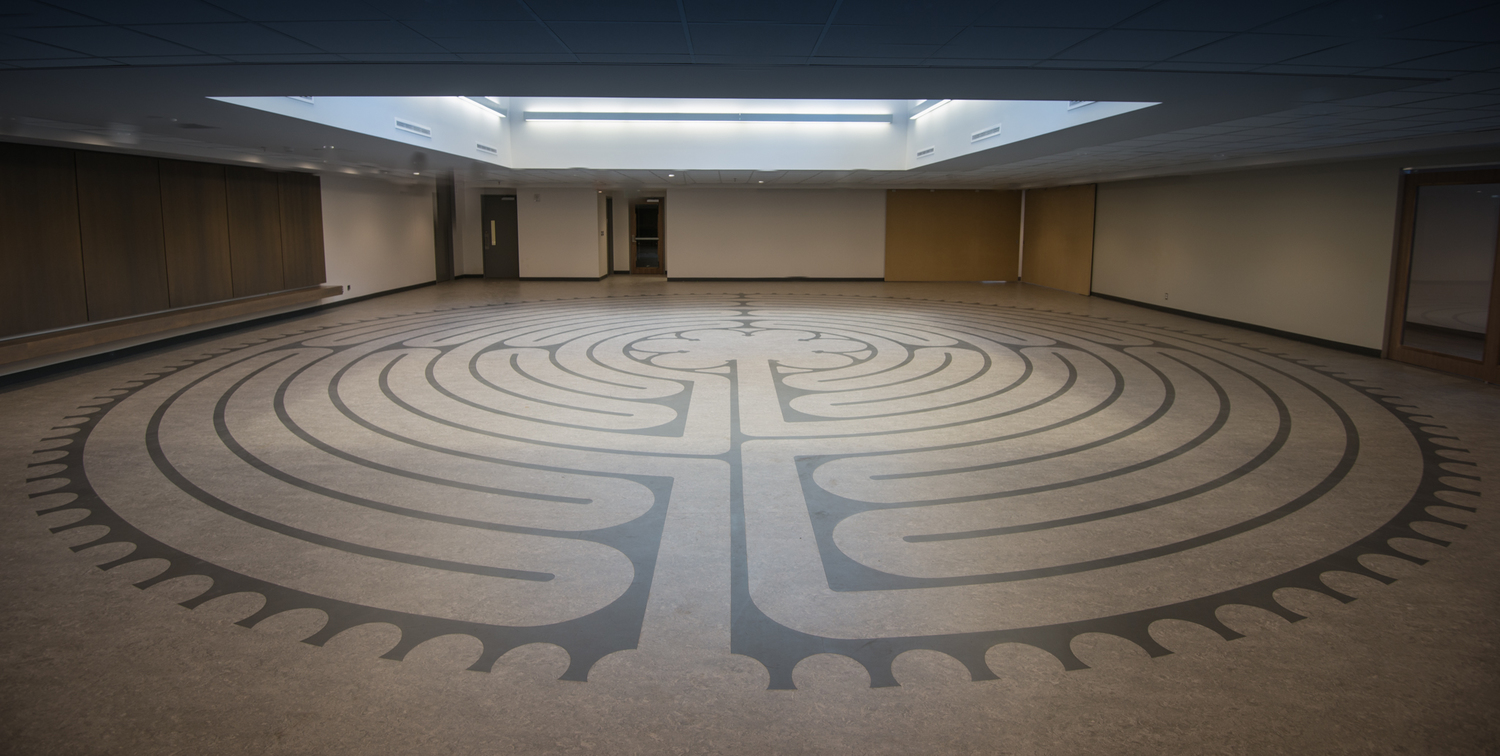
Labyrinths and mazes are not the same, however both are patterns for a path from the entrance to the centre. Though the terms are often used interchangably, they mean different things. Mazes are a kind of puzzel with multiple paths and decision points, and sometimes high walls. Labyrinths, by contrast, are unicursal: a single path twisting and turning through several concentric circles or circuits to arrive at a central goal, without walls or other obstructions to visibility. There are no “wrong turns” in a labyrinth.
The labyrinth at Christ Church Cathedral in Ottawa, is a replica of the 13th century eleven-circuit labyrinth at Notre Dame Cathedral in Chartres, France, the first of many installed in French Cathedrals built during the Middle Ages. The design of the labyrinth pattern makes use of the intricate spacial relationships known as sacred geometry, visible in the balance between line and path widths, centre and perimeter diameters and the lunations of the scalloped outer corona. Growth patterns in nature follow the same principles and architecture based on sacred geometry resonates harmoniously in human perception.

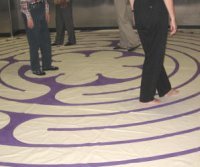
Walk the Labyrinth
Follow the path, one step at a time. Make a prayerful preparation. Stand at the entrance, breathe deeply a few times, relax, and still your mind. Take your shoes off if it helps you feel more grounded. Take your time. Find your own pace. Coordinate your footsteps with your breathing if that helps.
Let go of any expectations you may hold, and observe your experience as it unfolds. You could ask yourself at each turn: “What am I turning away from in my life? What am I turning towards?” You could ask for guidance and insight into a concern of your own, or on behalf of someone else. You could pose a question at the onset. You could fill your mind with prayer, or sing quietly to yourself.
The labyrinth works at the intuitive “soul level” of the mind. Everything that happens is a metaphor, symbolic of something beyond. Remain open to receive subtle images, thoughts memories or flashes of insight. These can be fleeting so it helps sometimes to take paper and pen with you to capture them, and give yourself time after to journal or draw. If you wish to walk in again, feel free to do so
Labyrinth Facilitators
Healing Art of Self Care Retreat Facilitators
Robin Bailey
Robin Bailey has been coaching individuals through lifestyle transitions of all kinds and facilitating volunteer and community group interactions for the past two decades. Whether dealing with an individual’s personal struggles or a group’s dysfunctional relationship dynamics; she brings the focus, clarity and momentum that individuals and groups need to become “unstuck” and move forward. She’s been a labyrinth enthusiast since her first walk in 1998 and is passionate about sharing her enthusiasm with others, connecting them with this ancient and powerful tool for personal transformation.
Barbara Brown
Barbara Brown is a visual artist, Horticultural Therapist and Veriditas Labyrinth Facilitator. She uses her creative skills to offer transformative experiences in the labyrinth for well being. She has worked with the labyrinth experience since 2007 and brings her creative eye and supportive sensibilities to her work as a facilitator. As a Horticultural Therapist working in long term care she provided an adapted experience of gardening for the frail elderly.
The Rev. Canon Rhondda MacKay
The Rev. Canon Rhondda MacKay retired after serving parishes in Alta Vista, Westboro, Sandy Hill and Vanier. She served as Hospital Chaplain and staff of the Royal Commission on Aboriginal People’s. Currently she is exploring art in various modalities and seeking ways to be an honest Ally of First People’s.
Elspeth McEwen
Elspeth McEwen is a community psychiatrist and trained labyrinth facilitator (Veriditas). She has a graduate certificate in Expressive Arts (Fleming College, Haliburton) and is an active member of First United Church.
Finger-labyrinth meditation
“For a person familiar with labyrinth walking, but unable to walk due to illness or infirmity, using a finger labyrinth can be like gazing at a photograph of a beloved friend or family member, as it evokes memories of those sacred times and experiences.”
Elspeth MacEwan
Cathedral Labyrinth Guild”
Instructions
- Before you begin, remember the blessings in your life. Frame any issues you would like resolved into a healing question, if possible.
- As you open your eyes, relax your neck and shoulders and release your mind from distracting thoughts. Inhale and exhale slowly three times.
- Place the index finger of your non-dominant hand (e.g., if you are normally righthanded, use your left hand and vice-versa) at the entrance to the labyrinth and enter. If uncomfortable, use your dominant finger; on each subsequent walk, however, try to use your non-dominant one as it facilitates concentration.
- Use your finger to slowly trace the pattern of the labyrinth; focus on following the path.
- Proceed to the centre, rest and breathe deeply, receive the wisdom that comes to you.
- When you are ready, return by retracing the path out of the labyrinth.
- Sit back and relax. You may want to jot down notes on your experience in a journal or other medium.


