Tour the Cathedral

There are many aspects of the Cathedral to explore and experience.

Tour the Cathedral

1832

The Cathedral, which stands on the traditional territory of the Algonquin Anishinaabe, had its beginnings in 1832, as the first Anglican church in Bytown, a roughhewn settlement established for the building of the Rideau Canal. The first church was a simple stone building with planks for pews and only one wood stove against the bitter chill of winter.

1839

Creation of 516 pound bronze bell that was specially cast for the original church in. It rang to celebrate the creation of Canada on July 1, 1867, and continues to ring for services today.

1872

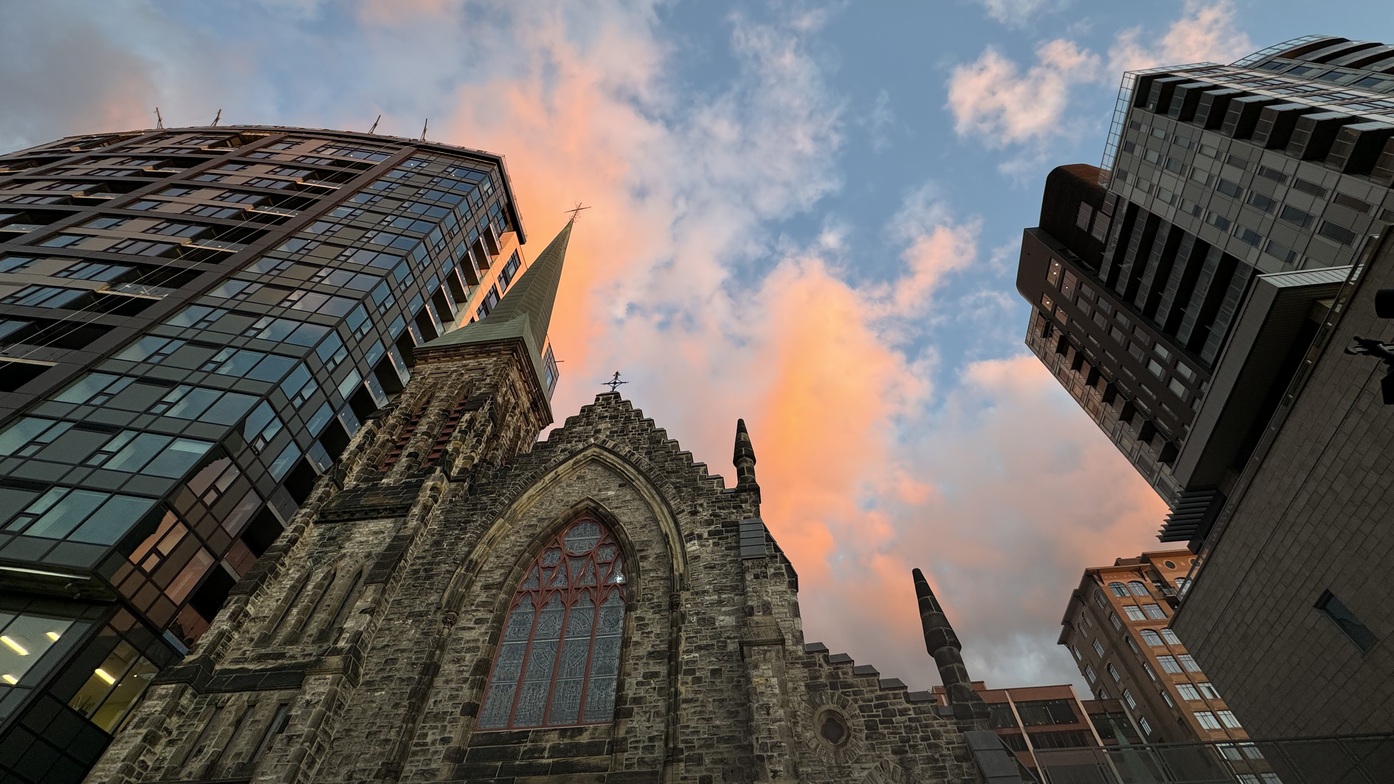
The growing lumber trade and the selection of Ottawa as the capital of Canada brought rapid growth to the town, and despite several renovations, Christ Church’s congregation soon outgrew its original church. The current building was built in 1872, designed by King Arnoldi, who helped design the original Parliament buildings.

1897

In 1897, it was named the cathedral of the newly created Diocese of Ottawa.
1979

In 1979, Christ Church Cathedral Ottawa was formally designated the Cathedral of the Anglican Military Ordinariate of the Canadian Forces.

1982

“West” window was commissioned to celebrate the 1982 sesquicentennial of the founding of Christ Church Bytown. The cross at its centre represents the confluence of the Ottawa, Rideau and Gatineau rivers, a meeting of waters that has been an important gathering place for people since time immemorial. Filling the lower portion of the window are crowds of people, representing the diversity of the population served by Christ Church over the years, and at the top sits Christ the King, holding the Cathedral safe in his arms.

1996

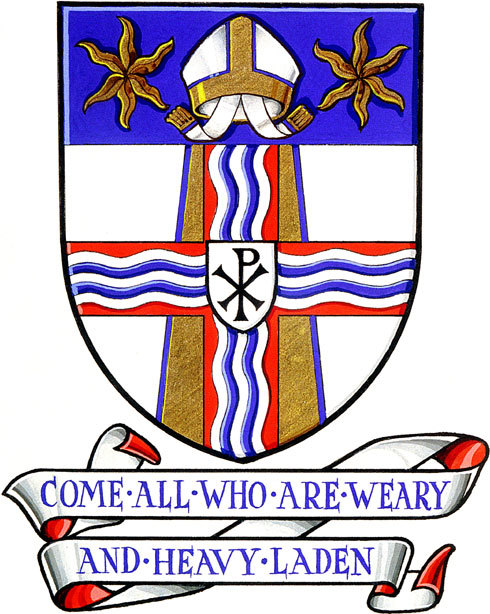
In 1996, the Canadian Heraldic Authority presented the Cathedral with its Coat of Arms. The white mitre indicates the Cathedral as the Seat of the Bishop. On each side of the mitre are heavenly stars: the blue background signifies the heavens., with golden rays of light shining down. On the red cross of St. George’s, a wavy cross, representing the confluence of the Ottawa River, the Gatineau River, and the Rideau River. At the junction are the Greek letters Chi and Rho, which begin the word Christ.

2018

In 2018, Christ Church Cathedral Ottawa became members of the international Community of the Cross of Nails. According to Dean Parker, “our membership in the CCN is not simply a recognition of our long involvement in ministries of reconciliation. It is about our commitment to reconciliation as central to Christian ministry, as well as a commitment to share our experiences and to learn from others across the world.”

More information about the Community of the Cross of Nails in North America.

More information about the International Community of the Cross of Nails.

Background

Following the bombing of England’s Coventry Cathedral in 1940, its provost, the Very Reverend Richard Howard, made a commitment not to seek revenge, but to strive for forgiveness and reconciliation with those responsible. Using a national radio broadcast from the cathedral ruins on Christmas Day 1940 he declared that when the war was over he would work with those who had been enemies “to build a kinder, more Christ-child-like world.” It was this moral and prophetic vision which led to Coventry Cathedral’s development as a world Centre for Reconciliation.

A major part of its ministry is the Community of the Cross of Nails, which is today an international network of Christian churches, organizations and other faith communities, all drawn together by the story of Coventry Cathedral, and sharing a common commitment to work and pray for peace, justice and reconciliation.

The Chapel of Reconciliation

In 2017, Coventry’s Canon for Reconciliation, the Reverend Dr Sarah Hills, presented Christ Church Cathedral Ottawa with a cross of nails to signify its partnership in the Community of the Cross of Nails. As a partner, this Cathedral shares in the tasks of healing the wounds of history, learning to live with difference and celebrate diversity, and building a culture of peace.

Upon becoming a partner of the Community of the Cross of Nails, the east transept of the Cathedral was named the Chapel of Reconciliation. It is a space where the Cathedral’s pastoral ministry of healing and reconciliation often takes place, and where its role as the Cathedral to the Anglican Military Ordinariate of the Canadian Forces, and its chaplains, is recognized.

On the Chapel’s walls hang framed regimental colours, many with battle honours that serve as a reminder of the terrible cost of an unreconciled world.

The Coventry Cross of Nails is mounted here, in this quiet, peaceful Chapel of Reconciliation, with the simple words “Father forgive” beneath it. Every Friday, along with other partners around the world, the Coventry Litany of Reconciliation is prayed in the Cathedral:

All have sinned and fallen short of the glory of God:

The hatred which divides nation from nation, race from race, class from class, Father forgive.

The covetous desires of people and nations to possess what is not their own, Father forgive.

The greed which exploits the work of human hands and lays waste the earth, Father forgive.

Our envy of the welfare and happiness of others, Father forgive.

Our indifference to the plight of the imprisoned, the homeless, the refugee, Father forgive.

The lust which dishonours the bodies of men, women and children, Father forgive.

The pride which leads us to trust in ourselves and not in God, Father forgive.

Be kind to one another, tender hearted, forgiving one another, as God in Christ forgave you.

Cathedral Restoration

Overview

In 1988, an engineering report indicated that important repairs and restoration were required if the Cathedral was to serve the parish, the Diocese and the National Capital for the next hundred years.

By City of Ottawa By-Law 77-80, the Cathedral is a “property of architectural and historical value or interest” under the Ontario Heritage Act (1974). This designation applies only to the exterior of the Cathedral and does not apply to the interior or Lauder Hall. This means the Cathedral must seek the approval of the City for any significant change in the exterior appearance of the Cathedral. The Cathedral is free, however, to make changes to the interior for aesthetic or liturgical purposes – for example, to move the font from the Narthex to the front of the church, as was done in the 1980s.

In 1990, the well-known restoration architect Julian S. Smith was engaged to prepare a survey of the fabric of the Cathedral and a restoration master plan. He estimated the cost of required restorations would be about $3.5 million. Under the direction of a Restoration Committee, implementation of the master plan began in 1991 and has continued as funds become available each year. Funding for restoration is to be kept separate from the operating budget of the Cathedral. While there were, in the early years, a few small grants from the provincial and federal governments, the funding of restoration has come essentially from the parishioners and parish groups and a few well-wishers outside the parish.

Over the course of the intervening years, much work has been done. A new heating system has been installed. Roofs have been insulated. Lead-coated shingles, matching the Cathedral’s original roofing, have been installed. Extensive masonry repairs to walls and buttresses on all sides of the building, both above and below grade have been made… and continue to be made.

Windows have been repaired and renovated. Including the chancel, the nave, the bell tower, the clerestory windows and the large window over the main altar. Protective storm windows have been installed.

On the exterior of the building, three finial crosses on the roof peaks have been replaced. A handsome new cross, based on the original cross of 1872, tops the Cathedral spire. The bell housing and mechanism in the tower have been repaired so that the bell can be safely rung.

Restoration of the interior of the Cathedral has begun. Plaster repairs and repainting have greatly improved the appearance of the two entrance vestibules. New chandeliers, matching the originals, have been installed in the nave. At the front of the nave, hardwood flooring and old ceramic tile has been laid to match the tiling of the main aisle. Chancel walls have been replastered and repainted. The chancel floor has been repaired and refinished. Before proceeding further with interior work, additional repairs must be made to the stonework where there is evidence of water leaking through the walls of the Cathedral.

In 2017 a major push to restore stonework was undertaken in a project known as Restoration 120. The last major area of exterior restoration will be the soaring south wall (behind the altar).

In 2019 the Cathedral undertook the repair and restoration of the interior of the santuary, chancel and chapels. This project known as Restoration 122 was completed as all the pews were reinstalled over the freshly painted floors and the memorial plaques remounted on the rear walls to continue sharing the stories of the Cathedral history.

Restoration 120

The venerable building we know as Christ Church Cathedral was constructed during the 1870’s, and became the mother church for the people of the Diocese of Ottawa when it was designated as its cathedral 120 years ago.

Its great grey walls have echoed to hundreds of services a year, decade after decade. They house ministries that enlighten many lives with the love and hope of God in Christ. They have welcomed individuals slipping in, families as they celebrate and mourn, the leaders of the nation, province and city, and those who come for the warmth of a diverse and vibrant community when facing hard times.

Now, those great grey walls are themselves facing hard times.

Although to the casual eye “the church on the bluff” looks as solid as a Laurentian cliff, closer inspection makes it clear that’s not the case. Take a look at the buttresses that line the garth on the west wall and you’ll immediately see the problem: the mortar in the joints has crumbled, cracks are appearing, and some unprotected stones are fracturing. Those buttresses are not for decoration —they hold up our massive roof. If they fail, the building fails. There are similar problems all over the building. Not far in the future, the gaps and cracking could well cause individual stones to fall, leading to the collapse of the walls.

We cannot delay taking action. We already have the engineering reports on what must be done. Now, we need your support to make the essential restoration of the Cathedral’s west wall possible—as part of a major restoration project in 2017 that will cost over $400,000. We are calling this project Restoration 120.

Your donation to Restoration 120 will have an immediate impact by directly funding $120,000 of urgent work that will be undertaken on the west wall of the Cathedral in 2017. And if we achieve that amount, your donation will directly fund other urgent restoration work in 2017, reducing our reliance on financing work by means of a mortgage or by depleting our endowment program.

2017 is the 120th anniversary of the designation of Christ Church as a Cathedral. Your donation will be used in this anniversary year to make the Cathedral’s walls safe, sound and lovely to behold.

I warmly encourage you to give generously to Restoration 120

Blair Seaborn
Chair, Restoration 120

Restoration 122

Christ Church Cathedral was constructed in the 1870s. Its stone, plaster and lathe walls have echoed to hundreds of services a year, decade after decade, providing a secure home to ministries that enlighten many lives with the love and hope of God in Christ. Now, those old plaster walls are in need of refreshment and renewal. Our ongoing work of restoring the Cathedral began over 30 years ago, and in that time more than $3.3million has been spent—almost all of it raised through donations. Most recently, the work has focused on major repairs to large sections of the exterior walls, as part of a systematic plan to address the restoration of the masonry of both the Cathedral and Lauder Hall by 2023. That work, begun in 2017, largely solved the problem of moisture seeping in, which allows us finally to undertake the much-needed repair, waterproofing and repainting of all the interior walls of the Cathedral. Because this work will require moving pews and setting up expensive scaffolding, it makes sense to install more effective ceiling fans and paint the floors at the same time. The combined cost of this long-awaited interior project is approximately $122,000—and since 2019 is the 122nd anniversary of the designation of Christ Church as the Cathedral of the Anglican Diocese of Ottawa, we’re naming this fundraising drive Restoration 122.

Your donation to Restoration 122 will help fund the repairing, waterproofing and repainting of the Cathedral’s inside walls, the repainting of its floors and the installation of new ceiling fans. If the goal of $122,000 is surpassed, we will be able to fund essential restoration work on the frame of the beautiful sesquicentennial window this year. We warmly encourage you to give generously to Restoration 122.

David and Peggy Morgan
Co-Chairs of Restoration 122

Anishinaabe aking ate awaso kikinawadjichigan
A place of prayer on Algonquin territory since 1832
The Anglican Cathedral in the Nation’s Capital
Cathedral of the Canadian Forces Anglican Military Ordinariate

Ottawa Anglican Diocese